Amblyopia Test & Screening App: How Our Mobile Lazy Eye Screening Works
A mobile screening workflow from Lazy Eye Games that combines monocular acuity, crowding sensitivity, and binocular depth perception into one guided amblyopia risk assessment.
The Amblyopia Test & Screening app from Lazy Eye Games is a guided mobile lazy eye screening app designed to look for clinically meaningful patterns that often appear in amblyopia: reduced monocular performance, exaggerated crowding, weaker stereopsis, and measurable interocular difference between the right and left eyes.
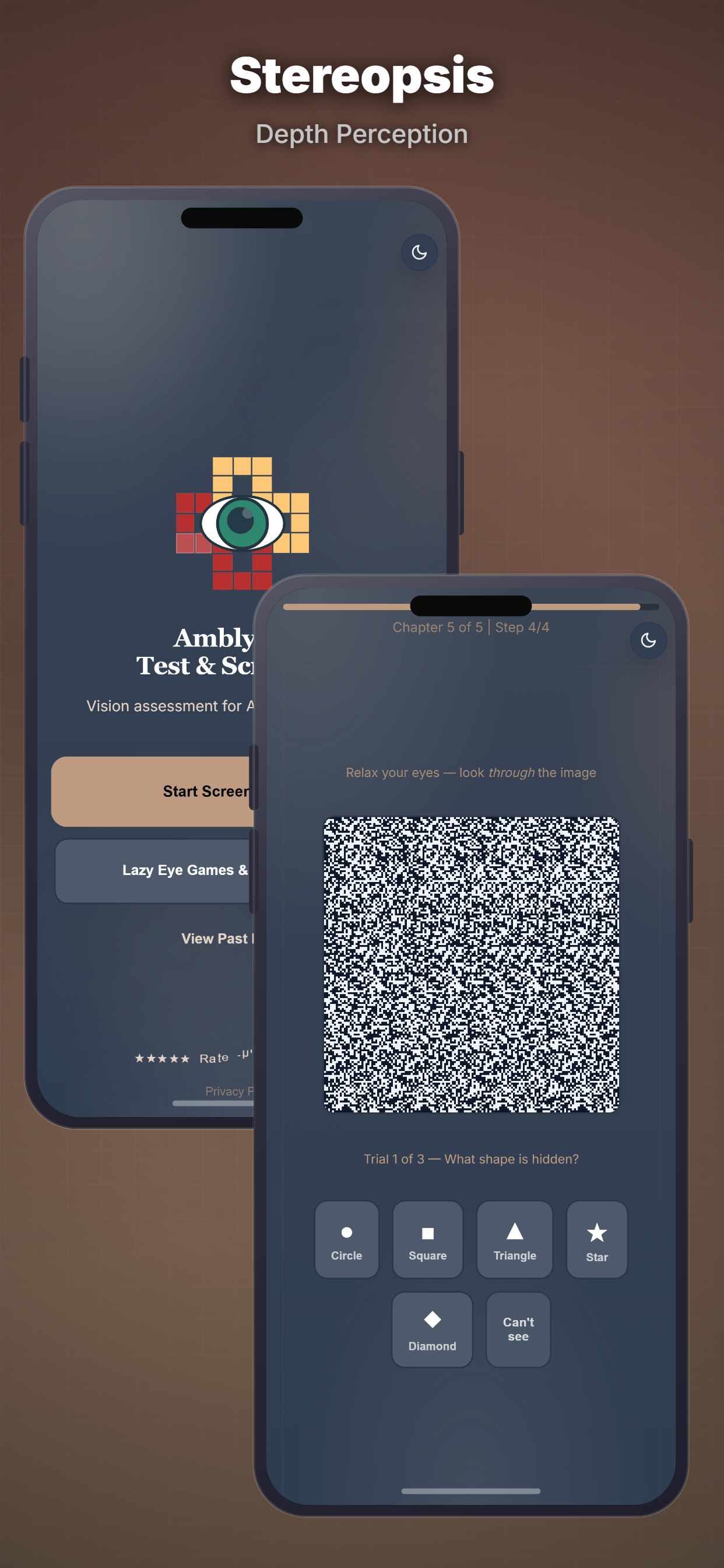
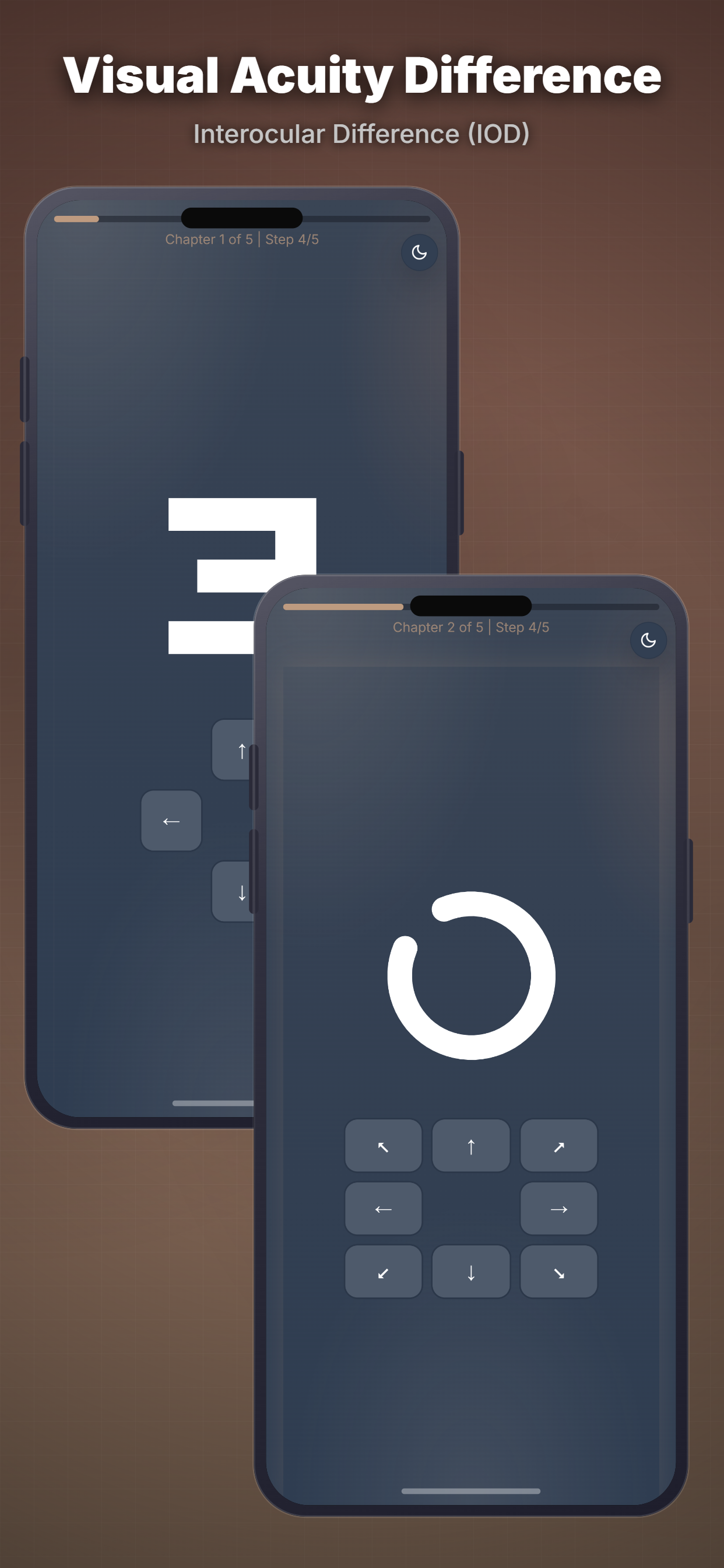
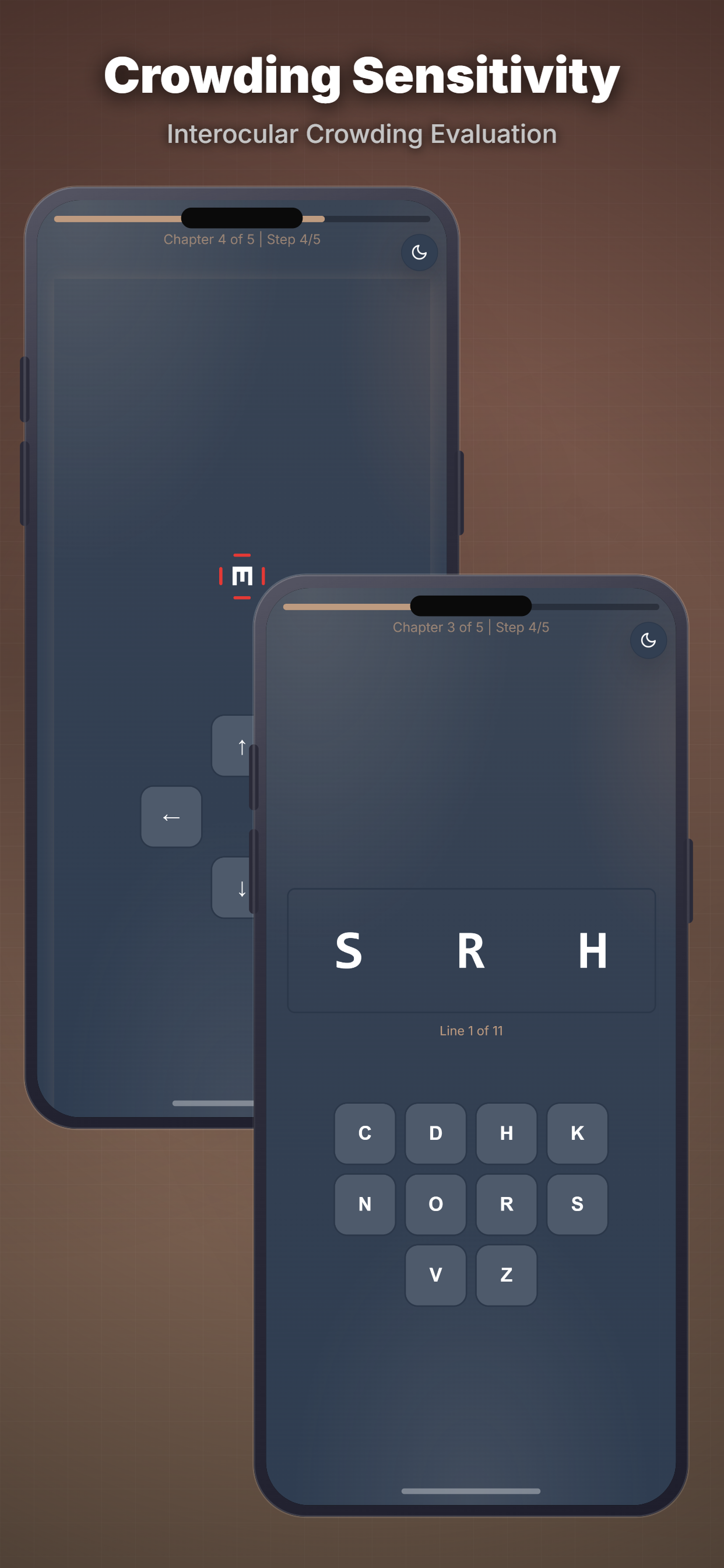
Instead of relying on a single chart, the app walks users through five complementary chapters: Tumbling E, Landolt C, LogMAR Crowding, Crowding Bars, and Stereogram depth perception. The result is a broader vision assessment that can help users decide when a full binocular vision exam is the right next step. It is a screening tool, not a diagnosis, but it is built on real optotype testing principles and empirical amblyopia screening practice.
See the App in Action
Watch a guided walkthrough of the five screening chapters, from Tumbling E and Landolt C acuity testing through LogMAR crowding, crowding bars, and the binocular stereopsis assessment.
What the Amblyopia Test & Screening App Measures
A good amblyopia screening app should not only ask whether a person can see small symbols. It should ask whether each eye performs similarly, whether nearby contours make recognition harder than expected, and whether both eyes still work together well enough to create reliable depth. That is exactly why this app uses five different tasks.
| Chapter | Test | What it measures | Why it matters in lazy eye screening | Selected studies |
|---|---|---|---|---|
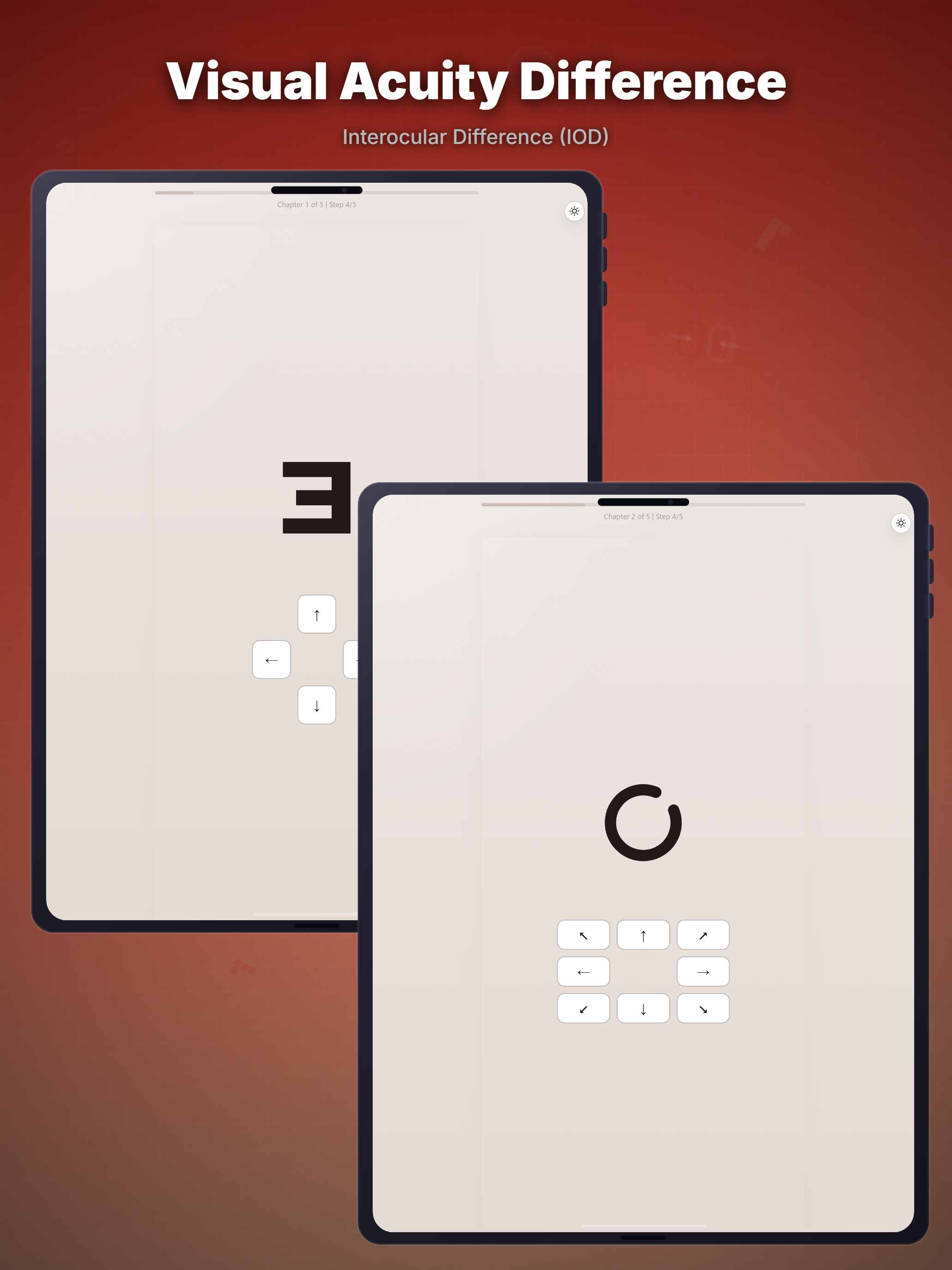
| 1 | Tumbling E | Monocular LogMAR-style direction recognition | Captures visual acuity asymmetry between eyes using a familiar clinical optotype. |
Tumbling E screening normative study (2018) Tumbling E vs Landolt C in managing amblyopia (2021) |
| 2 | Landolt C | Monocular gap-location acuity | Checks fine resolution with a second standardized optotype family so the result is not dependent on one symbol type alone. |
Landolt C tests with fixed separations detect amblyopia (2024) Landolt C vs Tumbling E in amblyopia management (2021) |
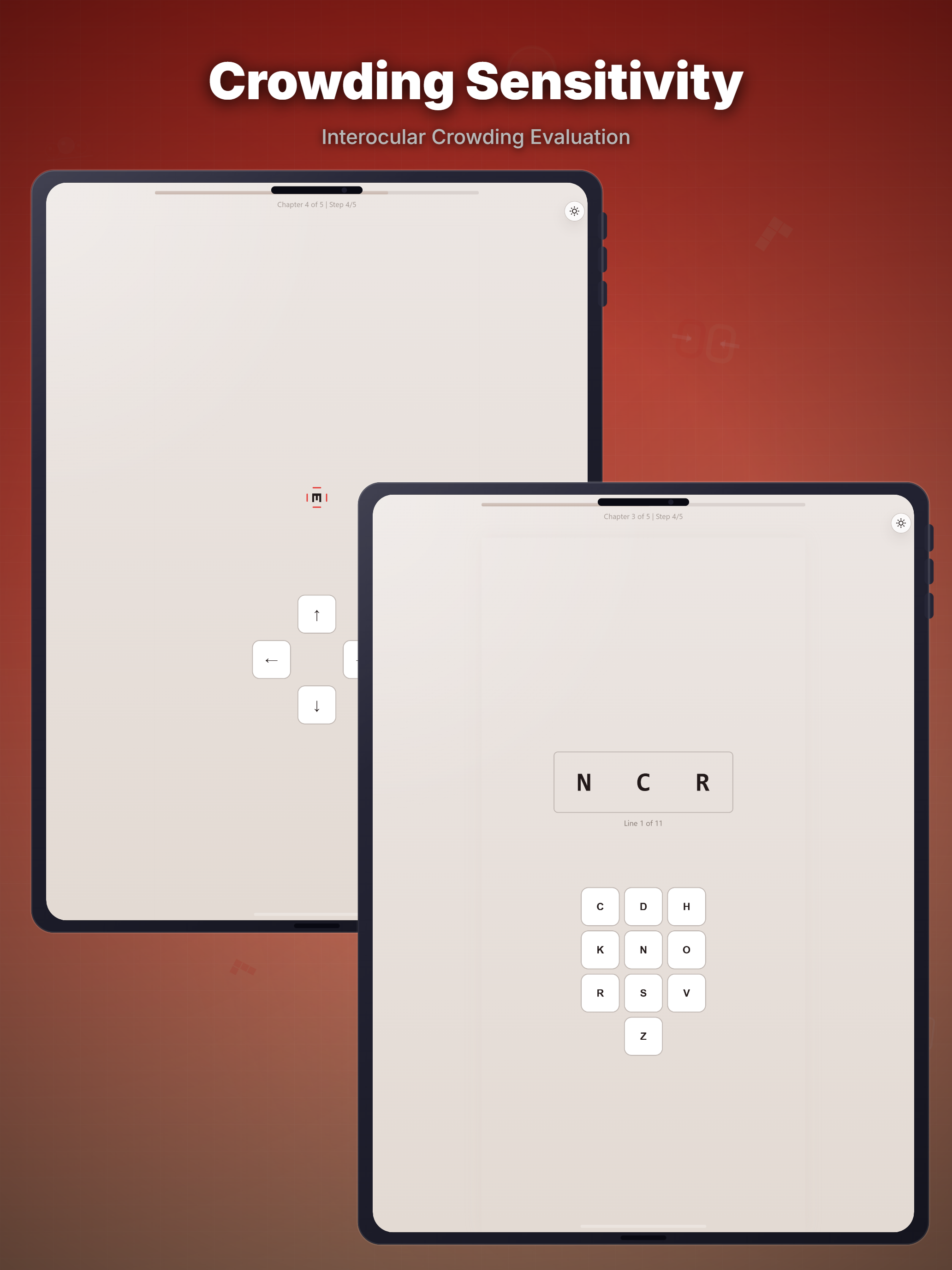
| 3 | LogMAR Crowding | Letter recognition with adjacent letters present | Crowding is often disproportionately difficult in amblyopia, even when a single isolated symbol is easier to identify. |
Log-scaled crowded acuity charts in amblyopia studies (2019) Visual acuity, crowding, and stereo-vision in amblyopia (2012) |
| 4 | Crowding Bars | Direction recognition with flanking bars | Measures how strongly nearby contours interfere with symbol recognition, another common amblyopia signal. |
Contour interaction in amblyopia: scale selection (2001) Contour interaction for flanked optotypes in amblyopia (1999) |
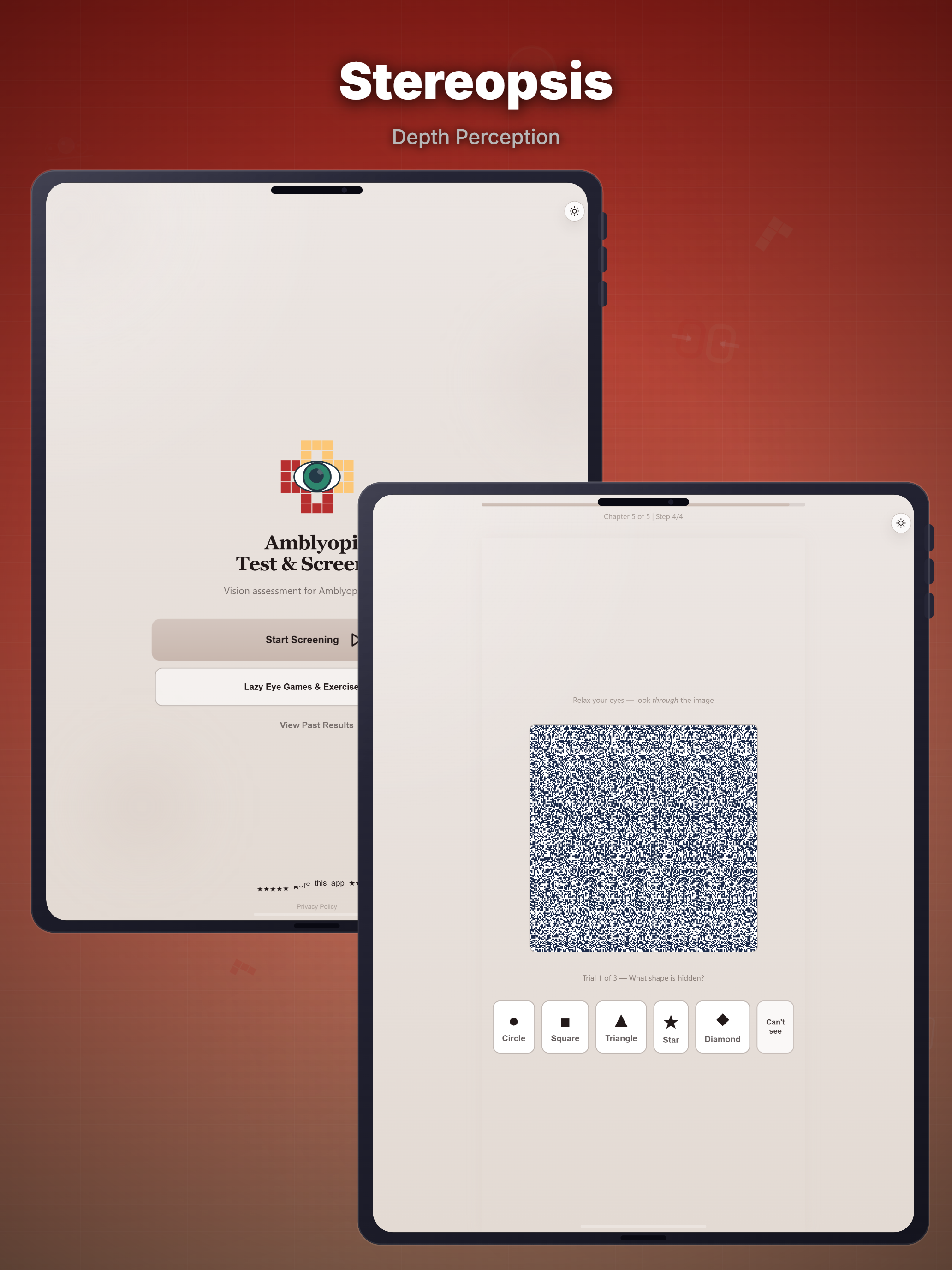
| 5 | Stereogram | Binocular depth perception on a 0 to 5 depth scale | Assesses stereopsis, which depends on both eyes contributing together rather than one eye working alone. |
Small-target random dot stereogram for preschool screening (1996) Dynamic random dot stereotests in pediatric screening (2019) |
The first four chapters are run one eye at a time, because amblyopia often shows up as a right-eye versus left-eye performance gap. The fifth chapter uses both eyes together and asks whether the brain can recover hidden depth from a random-dot stereogram. That combination of monocular and binocular testing is a much stronger screening pattern than a single-letter test alone.
Why Interocular Difference Matters More Than Raw Vision Alone
In real amblyopia screening, the most revealing question is often not, "How sharp is vision in absolute terms?" but rather, "How different are the two eyes from each other?" A person can have mediocre vision in both eyes for many reasons, but amblyopia frequently shows up as an eye-to-eye imbalance. That is why the app places strong emphasis on interocular difference (IOD) across the monocular tests.
This is also one of the reasons mobile screening can be useful when designed carefully. Both eyes are measured on the same device, at the same estimated viewing distance, with the same calibration logic. Even if the phone or tablet is not a perfect substitute for a clinical exam lane, the relative comparison between eyes remains informative because both eyes are affected by the same device conditions.
Inside the scoring model, the optotype-based chapters normalize eye-to-eye difference against a 0.5 LogMAR concern ceiling, roughly equivalent to about five ETDRS lines of asymmetry. That threshold reflects the clinical reality that larger differences between eyes deserve stronger concern than minor day-to-day variation.
Scientific Foundation: Familiar Clinical Concepts Adapted for Mobile Screening
The Amblyopia Test & Screening app is not a random collection of mini-games. Its tasks are rooted in measurement ideas that eye care professionals already recognize:
- Tumbling E and Landolt C are classic optotypes used when letter familiarity should not dominate the result.
- LogMAR crowding borrows from ETDRS-style line-based recognition, where nearby letters make the task harder in clinically meaningful ways.
- Crowding bars target contour interaction, a known weakness in many amblyopic visual systems.
- Stereogram testing checks binocular depth perception, an important functional outcome in amblyopia and binocular vision disorders.
The app also uses adaptive staircase logic for the first four chapters, a standard psychophysical strategy that narrows in on threshold by reducing symbol size or increasing task difficulty after correct responses. For mobile practicality, the app estimates viewing distance by device class and keeps minimum pixel floors so the optotypes remain displayable. In other words, this is a mobile workflow built around real visual measurement constraints, not a cosmetic quiz.
If you want broader background on the condition itself, see our guides on Understanding Amblyopia and Adult Binocular Vision, Depth Perception & Eye Coordination.
How the Lazy Eye Games Screening Score Is Calculated
The app presents one final risk score so the screening outcome is easier to interpret, but that score is built from several layers rather than one raw test result.
- Questionnaire score: Fifteen intake questions are mapped to internal concern values of 0, 50, or 100. The questionnaire score is the average answered value. If eight or more answers fall into the moderate-or-higher concern range, the questionnaire portion is forced to the top of the scale.
- Interactive score: Chapters 1 through 4 compare right-eye and left-eye thresholds. Tumbling E contributes 15%, Landolt C 15%, LogMAR Crowding 20%, and Crowding Bars 20%.
- Stereopsis contribution: Chapter 5 contributes 30% of the interactive portion by converting the depth score into a concern score. Lower stereogram performance increases risk.
- Skipped or floor chapters: If both eyes bottom out on the same monocular chapter, that chapter is treated as uninformative and the remaining interactive weights are renormalized.
- Composite score: The final result blends questionnaire and interactive findings at approximately one-third questionnaire and two-thirds interactive performance.
| Overall score | Screening category |
|---|---|
| 0 to 20 | Low Risk |
| 21 to 50 | Moderate Risk |
| 51 to 100 | High Risk |
That structure is intentionally more informative than a pass-or-fail vision check. It gives extra weight to binocular findings, preserves the importance of eye-to-eye asymmetry, and avoids overvaluing a single chapter that may be weak for reasons unrelated to amblyopia.
What This Mobile Vision Screening App Can and Cannot Tell You
The Amblyopia Test & Screening app can be very useful when used for the right purpose. It can:
- Flag meaningful asymmetry between the two eyes
- Surface crowding-related performance problems that basic chart screening may miss
- Check whether stereopsis or depth perception looks reduced
- Give you repeatable same-device screening snapshots over time
What it cannot do is diagnose the underlying cause of the result. It cannot replace cycloplegic refraction, alignment testing, suppression analysis, or a full binocular vision workup by an optometrist or ophthalmologist. If the result is moderate or high risk, or if symptoms include an eye turn, frequent squinting, covering one eye, poor depth perception, double vision, headaches, or sudden vision change, professional evaluation is the correct next step.
Why Lazy Eye Games Built a Screening App Alongside Training Tools
Lazy Eye Games has long focused on amblyopia education, binocular vision, and practical at-home tools. A screening product fits that mission because many users first need clarity: is the issue likely monocular blur, binocular imbalance, crowding sensitivity, reduced stereopsis, or a combination of those signals? A more structured screening workflow helps users and families take the next step with better information.
That also makes the article ecosystem on this site more useful. Users can read about the science behind amblyopia, the functional importance of binocular vision and depth perception, and the role of broader vision therapy methodologies, then use the app to collect a structured screening snapshot before speaking with a professional.
Frequently Asked Questions About a Mobile Lazy Eye Test
Is the Amblyopia Test & Screening app a diagnosis?
No. It is a screening and risk-stratification tool. Only a qualified eye care professional can diagnose amblyopia, strabismus, refractive error, or another ocular condition.
Do I test one eye at a time?
Yes for the first four chapters. The app guides the user to cover one eye gently and keep the device at about arm's length. The stereogram chapter uses both eyes together.
Why include crowding tests in a lazy eye screening app?
Because amblyopia is not only about how small a single isolated symbol can be. Many amblyopic visual systems perform disproportionately worse when neighboring letters or contours are present. Crowding gives the screening model a more complete clinical picture.
What should I do if the app says Moderate Risk or High Risk?
Arrange a comprehensive eye exam. The app's results can help start the conversation, but the next step should be professional testing to determine whether the issue is amblyopia, binocular misalignment, prescription difference, suppression, or another vision problem.
The Bottom Line
The Lazy Eye Games Amblyopia Test & Screening app gives users a broader mobile vision assessment for amblyopia risk than a one-screen eye chart can offer. By combining optotype acuity, crowding evaluation, stereopsis, and structured intake questions, it helps surface patterns that matter in real-world lazy eye screening.
Used responsibly, it is a practical bridge between concern and professional care: strong enough to be informative, careful enough to acknowledge its limits, and transparent that the final risk model is a proprietary Lazy Eye Games screening metric rather than a stand-alone medical diagnosis.