Amblyopia Treatment by Gabor Patches
Perceptual Learning, How the Brain Rewires Itself Through Targeted Visual Stimuli
Loading interactive Gabor patch demonstration…
Above: A classic Gabor patch, a sinusoidal grating multiplied by a Gaussian envelope. This is the fundamental building block of perceptual learning therapy for amblyopia.
What Is a Gabor Patch?
A Gabor patch is a specialized visual stimulus that combines a striped sinusoidal grating with a smooth Gaussian blur that fades the pattern toward the edges. The result is a localized patch of stripes that is sharpest in the center and softly disappears at the boundary, like looking at a zebra through a fogged window that clears only in the middle.
Named after Dennis Gabor, the Nobel Prize–winning physicist who first described the mathematical foundation (the Gabor transform), these patches have become a cornerstone of psychophysics and perceptual learning. They are uniquely suited for vision therapy because they isolate exactly how the brain's visual cortex processes three fundamental properties:
- Orientation, the angle of the stripes
- Spatial frequency, how tightly packed the stripes are
- Contrast, how strongly the stripes stand out from the background
See the Parameters in Action
Each patch below varies exactly one parameter. Move your eyes across them to see how the brain perceives each change.
Loading…
The Science Behind Gabor Patches and Amblyopia
Amblyopia, commonly known as lazy eye, is not primarily an eye problem, it is a brain problem. The eye itself may be perfectly healthy, but the brain has learned to suppress its input. This is where Gabor patches become revolutionary: they speak the language of the visual cortex.
The visual cortex is organized into columns of neurons that respond selectively to specific orientations and spatial frequencies. When you look at a Gabor patch, you are directly stimulating these neural populations with a precisely controlled signal. For someone with amblyopia, the neural pathways serving the weaker eye have atrophied from disuse. Perceptual learning with Gabor patches forces those pathways to reactivate.
Perceptual learning is a clinically proven treatment that uses repetitive visual training exercises to improve vision in individuals with amblyopia by retraining the visual cortex to recover lost sharpness.
By patching or closing the strong eye and performing discrimination tasks with the amblyopic eye, the brain is forced to process the Gabor stimulus using only the weakened pathways. Over time, with consistent practice, those neural connections strengthen. The brain literally rewires itself to see more clearly.
Collinear Facilitation: Training Spatial Context
Isolating Spatial-Frequency Detectors
Neurons in the primary visual cortex (V1) are tuned to particular features, including edges, orientation, contrast, and spatial frequency. On a matched 50% gray background, a Gabor patch fades smoothly into its surroundings instead of presenting a hard outer edge. This reduces edge cues and makes the task depend more directly on detecting the patch's contrast and spatial-frequency pattern.
In amblyopia, the eye can be physically healthy while the brain gives its input less weight, particularly for faint or fine-detail signals. Perceptual-learning tasks can repeatedly challenge the reduced-contrast and high-spatial-frequency processing associated with the weaker eye, although they should complement, rather than replace, care from an eye-care professional. Learn more about perceptual learning and amblyopia research.
Lateral Interactions Between Aligned Patches
When Gabor patches with a similar orientation and spatial frequency are arranged end-to-end, their signals can support one another through a phenomenon called collinear facilitation. Neurons responding to one patch interact with neurons responding to nearby, aligned patches, which can improve detection of a faint target in the right spatial context. Read the study on collinear facilitation.
This is the principle behind flanker-style Gabor tasks: a faint central target is judged between aligned neighbors. Spatial interactions can be altered in amblyopia, so carefully controlled practice gives the visual system repeated opportunities to use these relationships while detecting low-contrast detail.
Key Parameters and Their Clinical Meaning
Mean Luminance
The baseline gray level around which the stripes oscillate. In clinical Gabor exercises, this must match the background exactly. If it does not, the patch becomes a luminance blob rather than a clean contrast-defined stimulus, and the brain can solve the task using brightness artifacts instead of the intended visual feature.
Contrast
Contrast controls how strongly the stripes deviate from the background gray. High contrast makes the pattern easy to see; low contrast pushes the visual system harder. In perceptual learning, reducing contrast is one of the most effective ways to increase difficulty and drive neural adaptation.
Spatial Frequency
This is the density of the stripes, how many cycles (light-dark pairs) fit across the patch. Low spatial frequencies have wide, widely spaced stripes. High spatial frequencies have tight, densely packed stripes. The amblyopic eye typically struggles more with higher spatial frequencies, making this a key training dimension.
Orientation
The angle of the stripes, measured in degrees or radians. Orientation discrimination, telling whether stripes are tilted slightly left or right, is one of the cleanest ways to scale difficulty in perceptual learning. The brain's orientation-selective neurons can be trained to finer and finer discriminations.
Sigma (Envelope Width)
Sigma controls how quickly the Gaussian blur fades the pattern toward the edges. A larger sigma produces a broader visible patch with more stripes; a smaller sigma produces a tighter, more localized patch. This parameter influences how much of the visual field is stimulated.
Contrast & Spatial Frequency Comparison
Notice how the patches become harder to distinguish as contrast drops and stripe density increases.
Loading…
How Lazy Eye Games & Exercises Uses Gabor Patches
The Lazy Eye Games & Exercises app is the most comprehensive and clinically grounded application of Gabor patch therapy available today. While other tools may offer a single Gabor exercise, Lazy Eye Games provides an entire ecosystem of 18 distinct Gabor-based activities, each designed to train a different aspect of visual processing:
Gabor Blocks
Match falling Gabor patches to targets by orientation and stripe density.
Gabor Diff
Spot the subtle difference between two nearly identical Gabor patches.
Gabor Hero
Fast-paced Gabor identification under time pressure.
Gabor Memory
Classic memory matching with Gabor patch pairs.
Gabor Crush
Match-three puzzle mechanics with Gabor stimuli.
Gabor Grid
Grid-based pattern recognition with Gabor patches.
Gabor Constellation
Lateral-masking practice that teaches the amblyopic eye to detect a faint target flashing between two darker flankers.
Gabor Crowding
Crowding-effect practice where distracting Gabor elements are cleared away so the player can stabilize and identify the central target.
Gabor's Birdy
Flappy-style gameplay with Gabor obstacles.
Gib Gab Goe
Unique Gabor-based reaction and discrimination game.
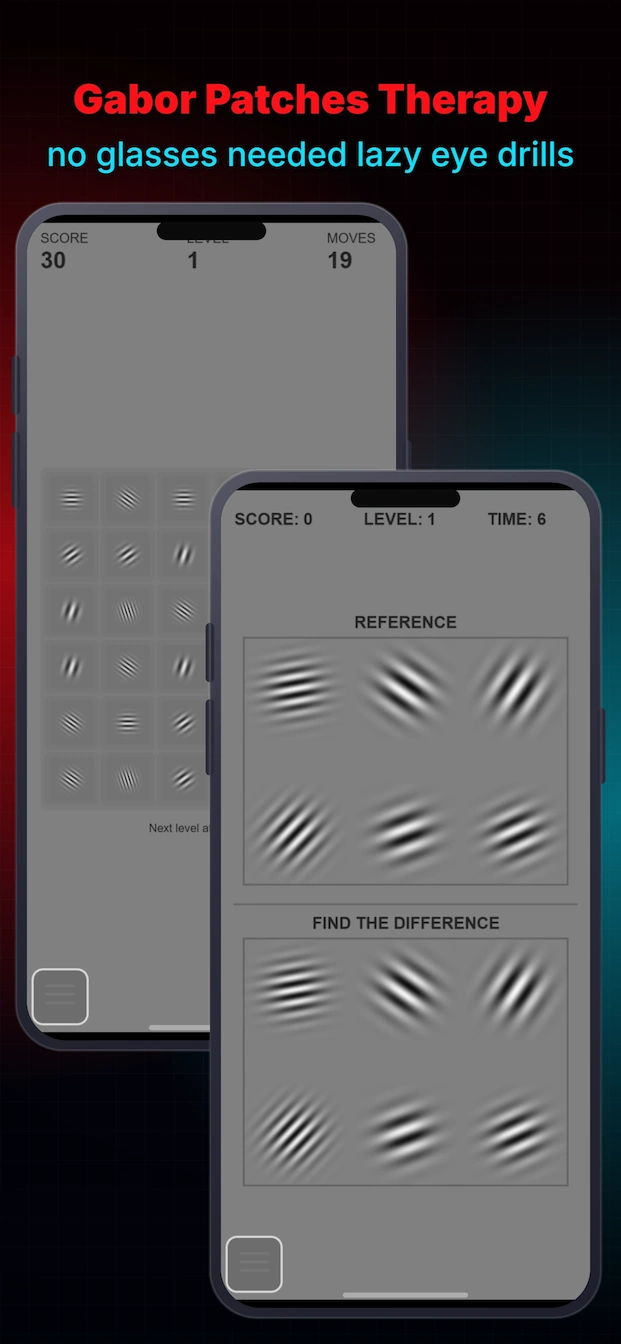
Gabor patch exercises in the Lazy Eye Games & Exercises app, clinical-grade perceptual learning for amblyopia
And that is just the games! The app also includes eight dedicated Gabor exercises for focused, clinical-grade training:
- Gabor Float, Track drifting Gabor patches across the screen
- Gabor Match, Find the matching Gabor patch among decoys
- Gabor Flash, Identify briefly flashed Gabor stimuli
- Gabor Spin, Discriminate rotating Gabor orientations
- Gabor Axes, Align Gabor patches to a target axis
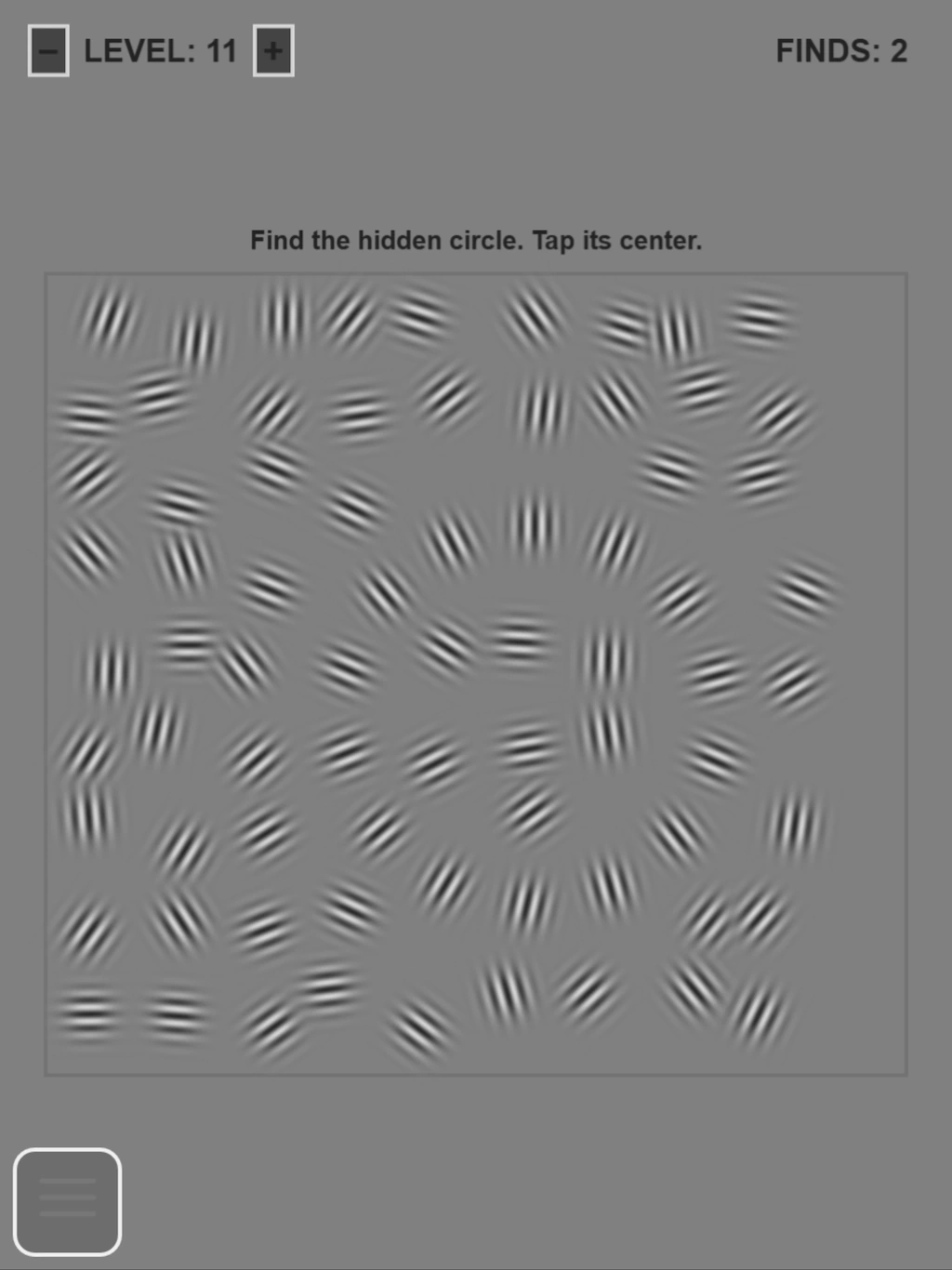
- Gabor Contour, Segment a hidden circular contour from a noisy field of randomly oriented Gabor patches
- Gabor Flanker, Detect a faint central Gabor target presented between collinear flankers
- Ball Tracking, Combines Gabor stimuli with smooth pursuit tracking
Research-Inspired Gabor Games in the App
Four of the app's monocular Gabor activities are built directly around classic perceptual-learning paradigms from the vision-science literature. Together they turn laboratory-style tasks into something repeatable at home while preserving the visual challenge that makes the training meaningful.
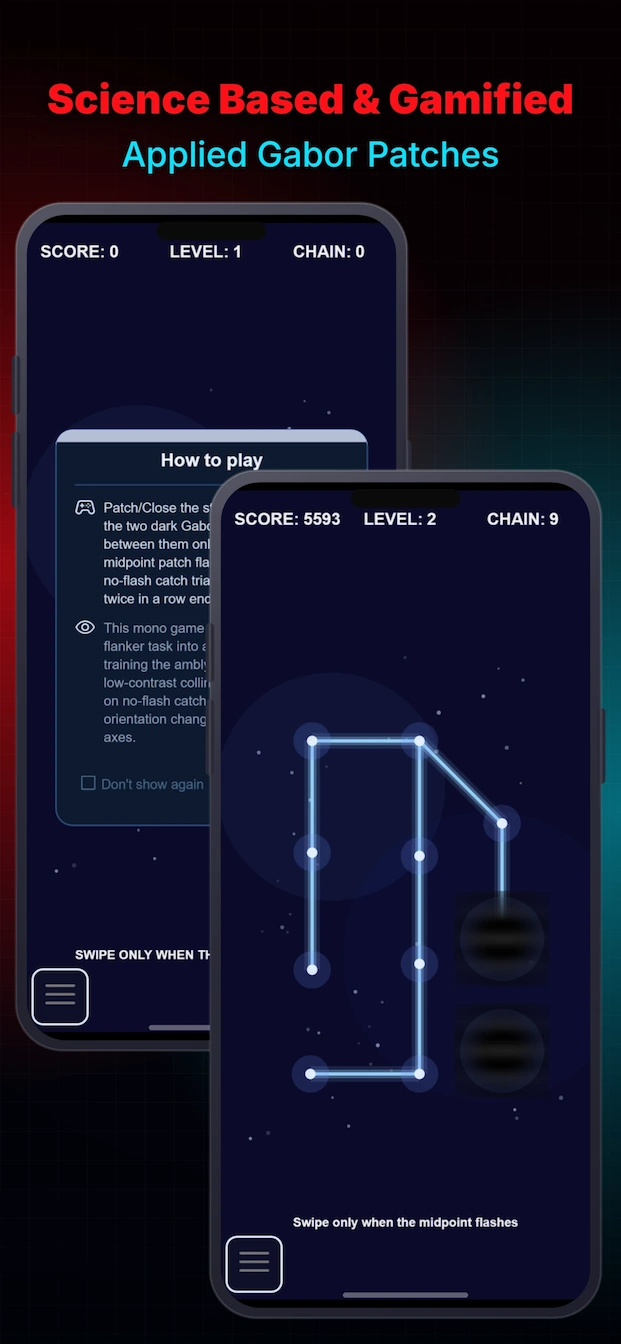
Gabor Constellation
Based on a lateral-masking flanker task, this monocular perceptual-learning arcade game asks the player to swipe only when a faint midpoint target briefly flashes between two darker Gabor flankers. The task trains low-contrast target detection under tightly controlled spatial context.
Study inspiration: Polat, Ma-Naim, Belkin, and Sagi, 2004.
Read the PNAS study on lateral masking and perceptual learning
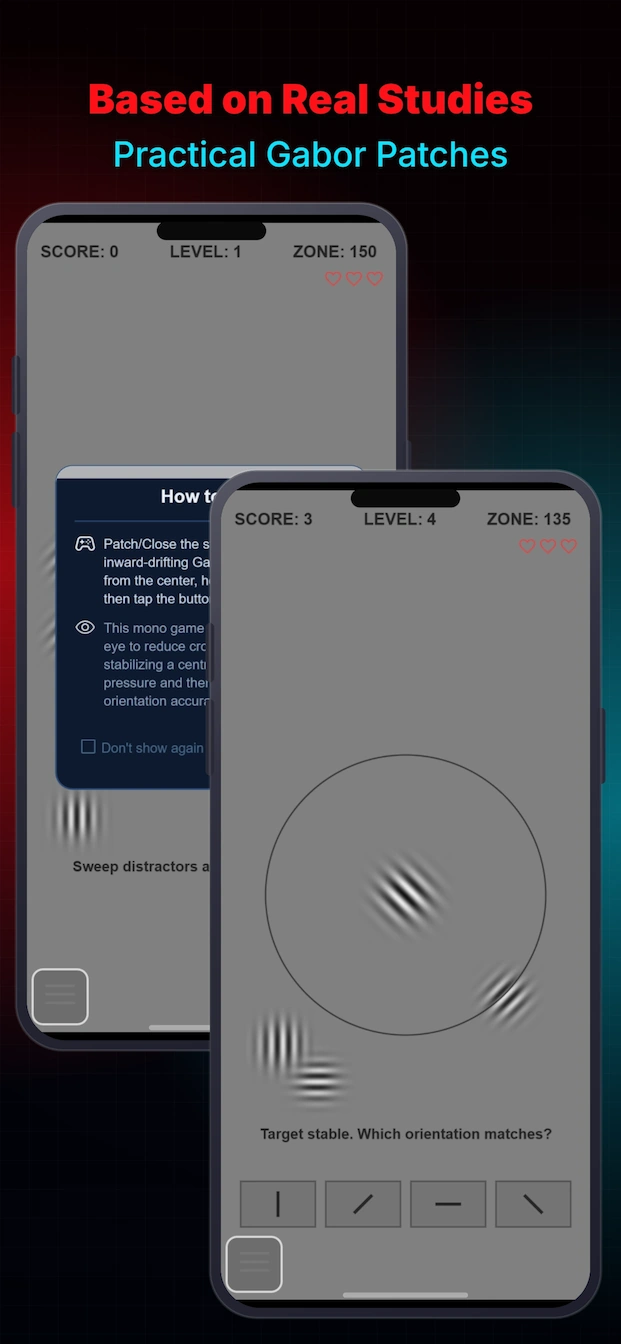
Gabor Crowding
Built around the crowding effect, this monocular perceptual-learning game has the player sweep inward-drifting Gabor distractors away from a central target, hold the target stable for a sustained window, and then identify its angle. That sequence targets clutter tolerance, fixation stability, and orientation discrimination together.
Study inspiration: Levi, Song, and Pelli, 2007.
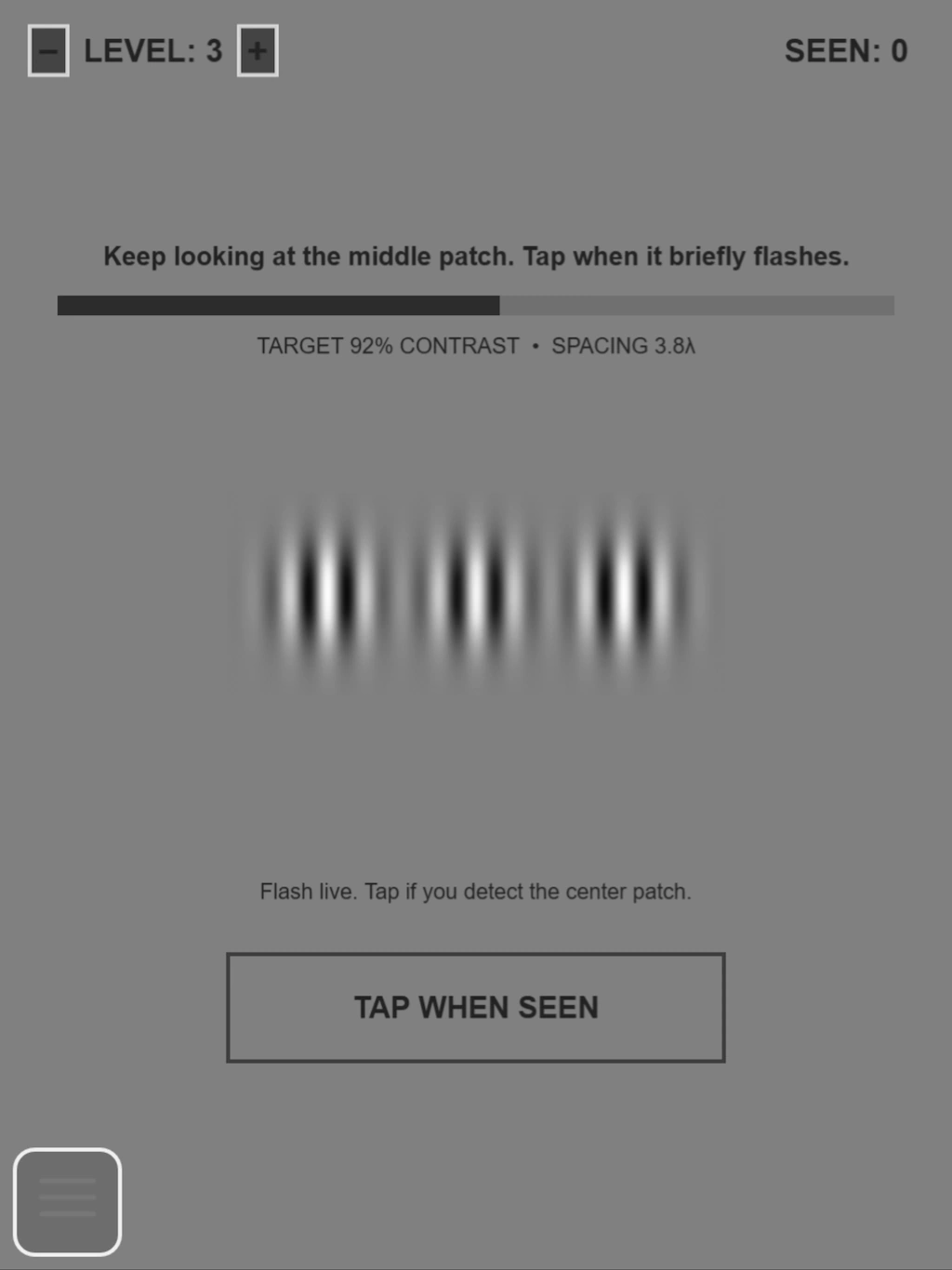
Gabor Flanker
This exercise adapts the classic lateral-masking flanker paradigm into a short, repeatable mobile task. The amblyopic eye must detect a faint central Gabor target in the presence of strong collinear flankers as contrast drops and spacing tightens, directly training signal detection under structured spatial context.
Study inspiration: Polat, Bonneh, Ma-Naim, Belkin, and Sagi, 2005.
Read the Vision Research study on spatial interactions in amblyopia
Gabor Contour
This hidden-shape exercise trains global contour integration by embedding a circle made of tangent-aligned Gabor patches inside a noisy field of identical patches with random orientations. The only way to solve the task is to link local features into a single global form and segregate the contour from noise.
Study inspiration: Hamm, Black, Dai, and Thompson, 2014, with contour-in-noise work summarized from Hess, Levi, Kovács, and related studies.
Read the Frontiers review on global processing and contour integration in amblyopia
Gameplay Footage
Here is a raw gameplay video showing the Gabor activities in motion, including the overall visual rhythm and interaction style used throughout the training set.
Orientation Discrimination Demo
Can you tell which patch has a different orientation? This is exactly the kind of task used in perceptual learning therapy.
Loading…
Why Lazy Eye Games Is the Best Tool for Gabor Patch Therapy
There are many vision therapy apps on the market, but none approach Gabor patch training with the depth and scientific rigor of Lazy Eye Games & Exercises. Here is what sets it apart:
Unmatched Variety
With 18 Gabor-based activities, the app ensures you never plateau. Each activity targets a different cognitive skill, matching, discrimination, memory, tracking, reaction time, contour linking, and signal-from-noise segregation, while all fundamentally training the same visual pathways. This variety keeps the brain engaged and accelerates progress.
Clinical-Grade Parameter Control
Behind every Gabor patch in the app lies a sophisticated parameter engine that controls contrast, orientation, spatial frequency, phase, and sigma with scientific precision. The difficulty scales automatically as you improve, ensuring you are always training at the edge of your ability, the zone where neuroplasticity happens.
Gamified Engagement
The single biggest challenge in vision therapy is compliance. Patients who do not stick with their exercises do not improve. Lazy Eye Games solves this by wrapping every Gabor exercise in a fun, engaging game. You are not just staring at stripes, you are matching, crushing, remembering, and reacting. The therapy happens naturally as you play.
Comprehensive Vision Therapy Ecosystem
Gabor patches are just one piece of the puzzle. The app also includes dichoptic (3D glasses–based) training for anti-suppression, fusion, and stereopsis. This means you can address every aspect of amblyopia in a single, integrated tool. The Gabor exercises handle the monocular perceptual learning while the dichoptic games rebuild binocular cooperation.
Getting Started with Gabor Patch Training
Using Gabor patches for amblyopia treatment is simple with Lazy Eye Games:
- Download the app from the iOS App Store or Google Play Store.
- Close or patch your strong eye, Gabor exercises are monocular, meaning the amblyopic eye trains alone.
- Start with a game like Gabor Blocks or Gabor Match at an easy level.
- Practice for 5–15 minutes daily. Consistency matters far more than session length.
- Let the app guide your progression. As you improve, the difficulty automatically increases.
Try It Yourself
This interactive demo generates a random Gabor patch. Each time you refresh, you get a new combination of orientation, contrast, and spatial frequency, just like the exercises in the app.
Loading…
The Research Behind Perceptual Learning
The use of Gabor patches in amblyopia treatment is supported by decades of psychophysical research. Studies have consistently shown that:
- Perceptual learning can improve visual acuity in adults with amblyopia, challenging the long-held belief that treatment only works in kids.
- Improvements transfer to real-world visual tasks, not just the trained stimulus.
- Gains are maintained over time, suggesting lasting neural changes in the visual cortex.
- Combining perceptual learning with dichoptic training produces better results than either approach alone.
Lazy Eye Games & Exercises is built on this foundation. Every Gabor activity in the app is designed according to established psychophysical principles, with careful attention to parameter normalization, contrast safety, and difficulty progression.
Conclusion
Gabor patches represent one of the most powerful tools available for amblyopia treatment through perceptual learning. By delivering precisely controlled visual stimuli to the amblyopic eye, they retrain the brain's visual cortex to process fine detail, contrast, and orientation with greater accuracy.
Lazy Eye Games & Exercises takes this science and turns it into an engaging, comprehensive therapy platform. With 18 Gabor-based activities, clinical-grade parameter control, and automatic difficulty progression, it is the most complete Gabor patch therapy tool available anywhere.
Whether you are an adult who was told nothing could be done, or a parent looking for effective treatment for your child, Gabor patch training with Lazy Eye Games offers a scientifically validated path to better vision.