Dichoptic Training for Amblyopia: How It Works, Evidence, and Practicing at Home
A comprehensive guide to dichoptic vision therapy, what it is, how red-cyan glasses train the brain to use both eyes, and what the research really says about adults and kids
What Does "Dichoptic" Mean?
The word dichoptic comes from Greek roots: di meaning "two" and optic meaning "vision." In clinical terms, dichoptic presentation means delivering different visual stimuli to each eye simultaneously. This is distinct from binocular viewing, where both eyes see the same image, and from monocular viewing, where only one eye receives visual input.
Dichoptic training for amblyopia works by presenting separate visual information to the amblyopic (weaker) eye and the dominant (stronger) eye at the same time. The two streams of visual input are combined by the brain into a single percept, but only if both eyes contribute. This is the fundamental mechanism that makes dichoptic training different from older treatment approaches.
The most practical way to achieve dichoptic separation at home is with anaglyph 3D glasses, the classic red-cyan (or red-blue) glasses you might recognize from old 3D movies. The red filter blocks cyan light, and the cyan filter blocks red light. When a game or exercise renders part of its scene in red and part in cyan, each eye sees only its assigned channel. The brain must then fuse the two channels into one coherent image, training binocular cooperation in the process.
The Science: Interocular Suppression and Why the Adult Brain Can Still Learn
To understand why dichoptic training works, it helps to understand interocular suppression, the core neural barrier in amblyopia.
When the two eyes present the brain with significantly different images (due to strabismus, anisometropia, or other causes), the visual cortex faces a problem: combine two mismatched images and risk double vision, or ignore one image for clarity. In amblyopia, the brain chooses the latter. It suppresses input from the weaker eye, sometimes so thoroughly that the eye's visual acuity degrades over time.
This suppression is not a fixed, irreversible condition. Research has shown that suppression in amblyopia is a gating mechanism, a dynamic neural process that can be reduced with the right kind of visual input (Hess, Thompson, & Baker, 2014). Dichoptic presentation works by bypassing or reducing this suppression: because each eye sees essential but incomplete parts of the scene, the brain cannot solve the task using only the stronger eye's input. It must integrate both channels, which gradually weakens the suppression and strengthens binocular neural connections.
Perhaps most importantly, this mechanism works in adults as well as kids. For decades, the scientific consensus held that amblyopia treatment was only effective in a "critical period" during childhood. That view has been substantially revised. A growing body of evidence shows that the adult visual cortex retains significant neuroplasticity and can respond to structured dichoptic training (Levi & Li, 2009; Hess et al., 2012). While the mechanisms of plasticity differ between developing and mature brains, the adult brain can still learn to reduce suppression and improve binocular function.
Dichoptic Training vs Monocular Patching
The traditional treatment for amblyopia is occlusion therapy, covering the stronger eye with a patch for several hours a day to force the weaker eye to work. While patching has been the standard of care for generations, it has important limitations that dichoptic training may address.
| Aspect | Dichoptic Training | Monocular Patching |
|---|---|---|
| Mechanism | Presents different images to each eye, reducing interocular suppression and training binocular fusion | Occludes the stronger eye, forcing exclusive use of the amblyopic eye |
| Primary target | Binocular function, stereopsis (depth perception), anti-suppression | Visual acuity in the amblyopic eye |
| Typical format | 20-40 minutes of interactive games or exercises, usually engaging and gamified | 2-6 hours of wearing an adhesive patch over the stronger eye during daily activities |
| Compliance challenge | Low, sessions are typically short, engaging, and interactive | High, long wear times, skin irritation, social stigma, and boredom reduce adherence |
| Trains binocular cooperation | Yes, the core mechanism requires both eyes to work together | No, only the patched (weaker) eye is active; binocular fusion is not practiced |
| Depth perception benefit | May improve stereopsis directly through binocular fusion training | Indirect only, improved acuity in the weaker eye may later support binocular function |
| Evidence for adults | Multiple studies show improvements in binocular function and stereoacuity (Hess et al., 2012; Vedamurthy et al., 2015) | Limited evidence in adults; some studies show modest acuity gains but limited binocular improvement |
It is worth noting that some studies have found comparable visual acuity improvements between dichoptic training and patching (Maniglia et al., 2018). This does not mean dichoptic training is "no better", rather, it suggests that dichoptic training achieves similar acuity gains while also offering additional binocular benefits that patching alone does not provide. The two approaches may also be complementary: a treatment plan could incorporate both dichoptic games (for binocular training) and patched perceptual learning exercises (for targeted monocular improvement).
What Does the Research Show?
The clinical evidence for dichoptic training has grown substantially over the past two decades. Below is a summary of key findings, presented as a balanced picture, including areas where results are mixed.
Visual Acuity Gains
Several studies have reported that dichoptic training produces measurable improvements in visual acuity in the amblyopic eye, typically in the range of 1-3 lines on a standard eye chart. A landmark study by Hess and colleagues (2012) demonstrated that adults with amblyopia who used a dichoptic iPod-based treatment showed significant visual acuity improvements. A later randomized controlled trial by Holmes and colleagues (2016) found that a dichoptic video game produced similar VA improvements to patching in kids, with the added benefit of better compliance.
Stereoacuity and Binocular Function
One of the most promising outcomes of dichoptic training is improvement in stereopsis, fine depth perception that requires both eyes. Vedamurthy et al. (2015) found that adults who played a dichoptic custom-made action video game showed significant improvements in stereoacuity, with some participants gaining stereopsis who had none at baseline. This is a particularly important finding because stereopsis was historically considered permanently lost after the critical period.
Contrast Sensitivity
Some studies have reported improvements in contrast sensitivity following dichoptic training. This may be related to the reduction of interocular suppression: as the brain learns to accept input from the weaker eye, it also becomes more sensitive to contrast differences between the two eyes. However, the evidence for contrast sensitivity gains is less consistent than for visual acuity and stereopsis.
Mixed Results and Honest Limitations
It is important to acknowledge that the evidence is not uniformly positive. Some studies have found comparable outcomes between dichoptic and monocular training, suggesting that the mechanism of improvement may not always be uniquely binocular (Maniglia et al., 2018). Results also vary by amblyopia type: patients with anisometropic amblyopia (where the two eyes have very different prescriptions) may respond differently than those with strabismic amblyopia (where the eyes are misaligned). Some patients show minimal improvement, and the amount of gain varies widely between individuals.
Additionally, most dichoptic training studies to date have been relatively small, and the optimal dosing (session duration, frequency, total training period) is not yet firmly established. More large-scale, long-term trials are needed to refine treatment protocols and identify which patients are most likely to benefit.
How Dichoptic Training Works at Home with Red-Cyan Glasses
One of the most practical aspects of dichoptic training is that it can be done at home with inexpensive anaglyph 3D glasses, the same type used for old 3D movies, available online for a few dollars. Here is how the mechanism works in practice:
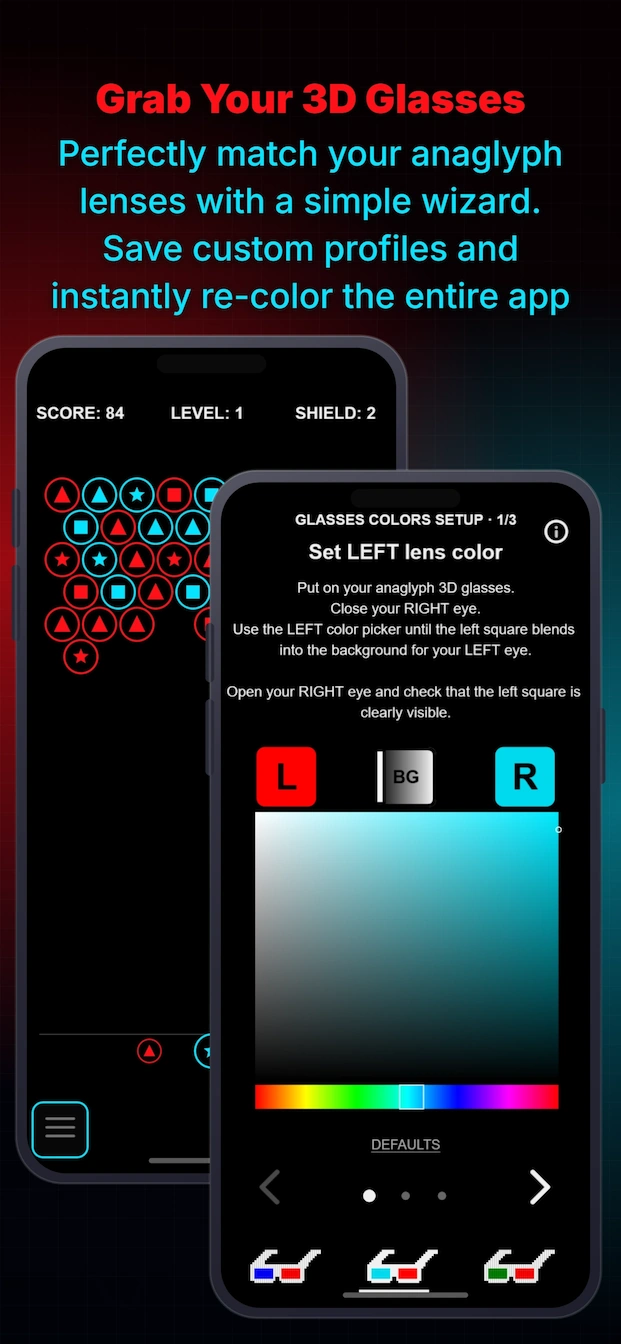
- Color calibration: The app or game displays two separate color channels, one rendered in a red hue, the other in a cyan (blue-green) hue. A calibration process adjusts the exact shades so that when you put on the glasses, each eye sees only its assigned channel.
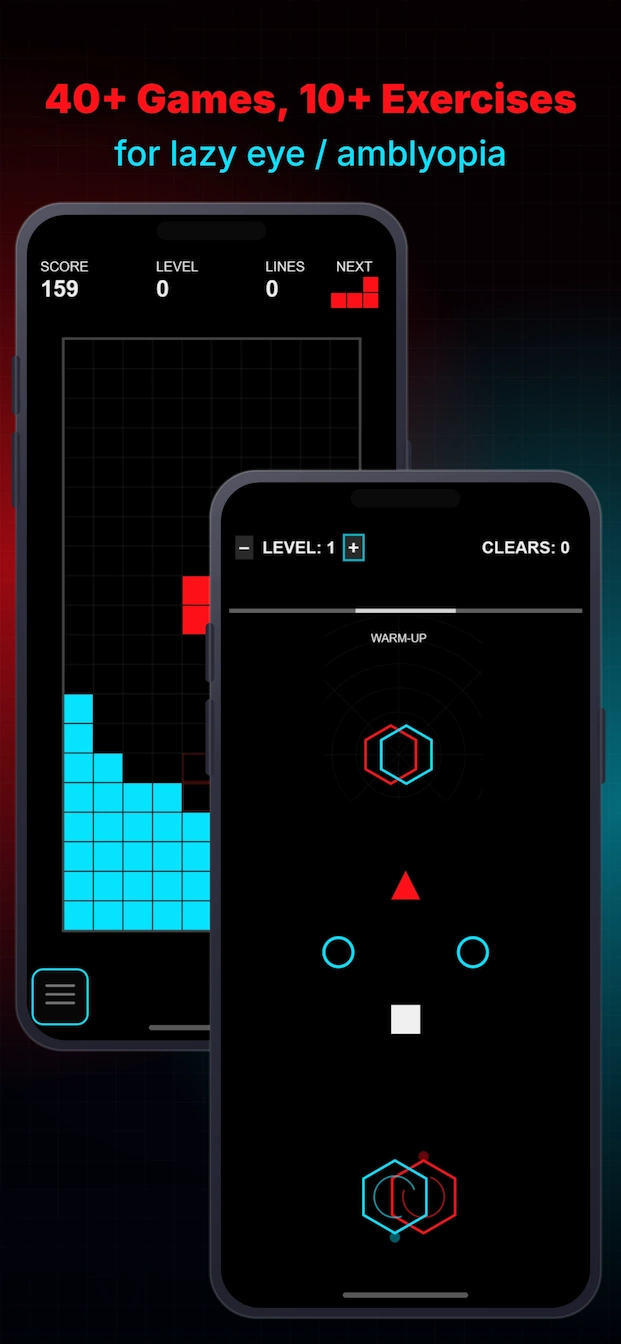
- Each eye receives unique content: For example, in a block-stacking game, the block currently falling might be rendered in the red channel (visible only to the left eye), while the stacked blocks at the bottom are rendered in cyan (visible only to the right eye).
- The brain must fuse: To stack the falling block on the correct target, you need visual information from both eyes. Your brain is forced to combine the red-channel image and the cyan-channel image into a single unified scene.
- Suppression is challenged: The stronger eye cannot solve the task alone because it does not see the complete scene. The brain must allow input from the weaker eye, which gradually weakens the habit of suppression.
This is fundamentally different from simply putting on 3D glasses to watch a movie. In a dichoptic training session, the visual task requires active participation and decision-making that depends on binocular integration, not passive viewing.
Color calibration is critical. The Lazy Eye Games & Exercises app includes a guided 3-step calibration wizard that walks users through the process of adjusting each eye's color until its assigned elements blend into the background when viewed through the wrong filter. This ensures that the dichoptic separation is as clean as possible, maximizing the therapeutic effect.
How Lazy Eye Games & Exercises Uses Dichoptic Training
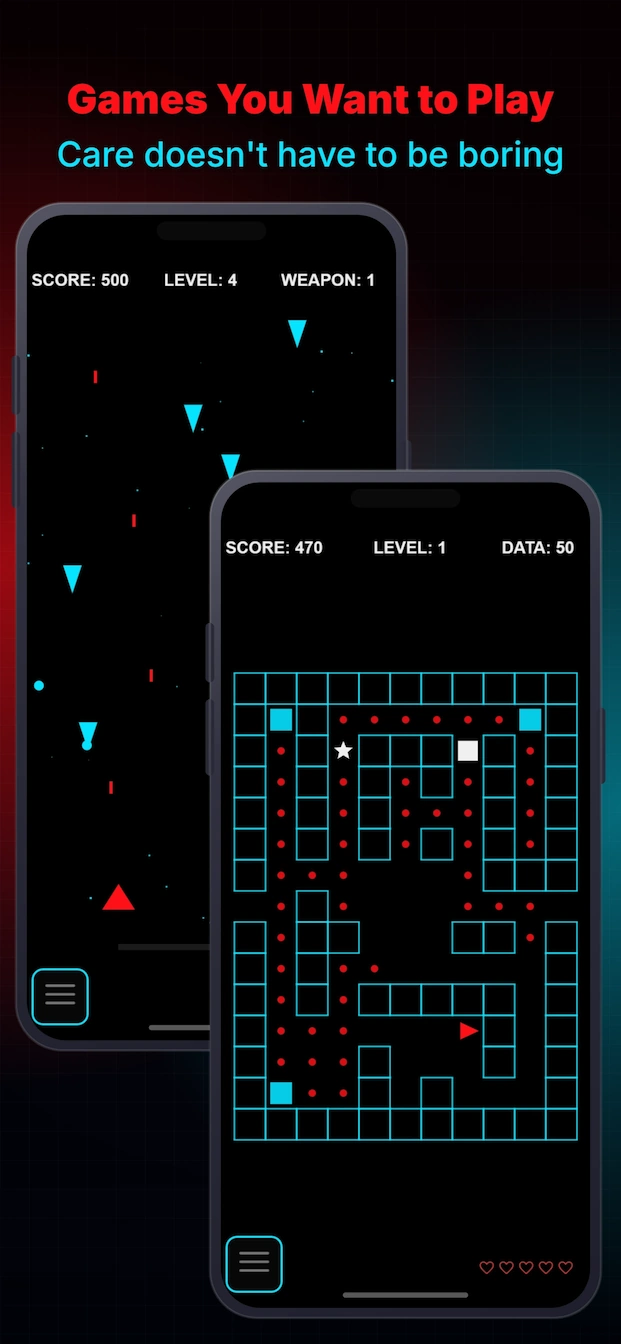
The Lazy Eye Games & Exercises app implements dichoptic training across dozens of games and exercises, all designed to support binocular vision training through anaglyph color separation. The app uses a calibrated color system in which every game reads three colors from the user's saved profile: a left-eye color, a right-eye color, and a shared background color.
Core Dichoptic Game Mechanics
The app's dichoptic activities span three clinical categories, each targeting a different aspect of binocular vision:
- Anti-Suppression: Games and exercises that force both eyes to contribute essential visual information. For example, ShapeMatcherScene is a bi-directional drag-and-snap dichoptic fusion exercise where one eye sees hollow sockets in its assigned color and the other sees solid cores. The player must match each core to its corresponding socket, a task that requires both eyes to provide complementary input. The app also includes PrismScene, a laser-routing game where the left-eye color channel carries the harmless direct beam and the right-eye color carries the reflected beam, each eye sees different critical parts of the same challenge.
- Fusion Training: Exercises designed to train sustained binocular fusion and vergence control. DivergenceBridgeScene is a sustained divergence dock-and-hold fusion trainer: the patient uses a horizontal spread rail to widen a dichoptic bridge while holding the gap within a stable range, training precise vergence control. TranaglyphScene (labeled "Anaglyphs" in the app) is a manual hold-and-release stretch trainer with left-eye and right-eye hexagonal targets drawn in calibrated colors.
- Stereopsis: Depth perception training through random-dot stereograms (StereogramScene), where slightly shifted images per eye create true 3D depth perception through anaglyph glasses.
Why the Dual-Therapy Approach Matters
Lazy Eye Games & Exercises combines dichoptic training with no-glasses perceptual learning using Gabor patches. This dual approach is intentional: dichoptic activities train binocular cooperation, while Gabor-based perceptual learning exercises train the amblyopic eye's contrast sensitivity, spatial frequency discrimination, and orientation processing through focused monocular practice. Using both methods within a single program may support broader visual improvement than either approach alone.
All dichoptic activities use the app's built-in color calibration system, which supports three profile slots with factory defaults for red-blue, red-cyan, and deep red-green. Each game reads the active profile's colors on every launch and refreshes them after any re-calibration, so the therapeutic color separation is consistent across the entire app.
Combining Dichoptic Training with Other Approaches
Dichoptic training is most effective when understood as one tool in a broader vision therapy toolkit. It can be combined with other evidence-based approaches:
Monocular Perceptual Learning (Gabor Patches)
As noted above, Gabor patch perceptual learning involves the weaker eye performing visual discrimination tasks while the stronger eye is patched. This targets contrast sensitivity, orientation discrimination, and spatial frequency processing, skills that support the amblyopic eye's basic visual function. When combined with dichoptic training, the goal is to improve both monocular capabilities and binocular cooperation in a complementary cycle.
Binocular Fusion Exercises
Traditional vision therapy exercises such as the Brock String, Barrel Card, and pencil push-ups train vergence and accommodation. These exercises do not require glasses and can be done as part of a broader routine. The app includes digital versions of several classic exercises, including VirtualBrockStringScene, BarrelCardScene, and VirtualFlipperScene (vergence flipper for convergence/divergence training).
Occlusion Therapy (Patching)
While dichoptic training may reduce or replace the need for patching in some cases, patching remains a valid component of amblyopia treatment, particularly for improving monocular visual acuity. Some treatment plans alternate between dichoptic sessions and patched perceptual learning, addressing both binocular and monocular goals.
For a broader understanding of how these approaches fit together, see our guides on Understanding Amblyopia and Vision Therapy Importance & Methodologies.
When to See an Eye Care Professional
Dichoptic training is a therapeutic tool, not a substitute for professional eye care. A comprehensive eye examination by an optometrist or ophthalmologist is essential before starting any vision training program. An eye care professional can:
- Diagnose the specific type and severity of amblyopia or binocular vision disorder
- Rule out contraindications such as uncorrected strabismus that might cause diplopia (double vision)
- Determine whether dichoptic training is appropriate for your specific condition
- Monitor progress and adjust the treatment plan as needed
- Provide guidance on integrating at-home training with in-office vision therapy
If you experience persistent double vision, headaches, eye strain, or sudden vision changes while training, stop and consult your eye care professional before continuing.
For more resources, including books, videos, and professional organizations, see our Recommended Resources page.
Frequently Asked Questions
Does dichoptic training work for adults?
Yes. Research by Hess and colleagues (2012) and Vedamurthy and colleagues (2015) has demonstrated that adults with amblyopia can achieve measurable improvements in visual acuity, binocular function, and stereopsis through structured dichoptic training. The adult visual cortex retains more neuroplasticity than was historically believed, and dichoptic training may help reduce interocular suppression at any age.
What glasses do I need for dichoptic training?
Standard red-cyan anaglyph 3D glasses are all that is required. The red filter passes red light to one eye while blocking cyan, and the cyan filter passes cyan light to the other while blocking red. Higher-contrast glasses with darker filters generally produce cleaner color separation and easier calibration. You can find affordable anaglyph glasses online. For detailed recommendations, see our Choosing 3D Glasses guide.
Is dichoptic training better than patching?
Different. Patching (occlusion therapy) targets monocular visual acuity by forcing the weaker eye to work alone. Dichoptic training targets binocular cooperation, anti-suppression, and depth perception. Some studies suggest dichoptic training can produce similar visual acuity gains to patching while also improving binocular function. The two approaches may be complementary rather than competing.
Can I use a phone or tablet for dichoptic training?
Yes. The Lazy Eye Games & Exercises app is designed for mobile devices and tablets, making it easy to do short dichoptic training sessions anywhere. The app's color calibration wizard adjusts the display colors to work with your specific glasses and device screen.
What is the difference between dichoptic training and 3D movies?
In a 3D movie, both eyes receive slightly shifted versions of the same visual scene to create a depth illusion. In dichoptic training, each eye receives fundamentally different visual information that must be integrated to complete a task. The active, goal-oriented nature of dichoptic training, requiring decision-making and hand-eye coordination, is what drives the therapeutic effect, not passive viewing.
How long before I notice improvement?
Many users report noticing improvements after about two weeks of consistent daily practice. Clinical studies typically train for several weeks to months, with sessions of 20-40 minutes per day. Consistency matters more than session length, shorter daily sessions are generally more effective than occasional marathon sessions.
References and Further Reading
- Hess, R. F., Thompson, B., & Baker, D. H. (2014). Binocular vision in amblyopia: structure, suppression and plasticity. Ophthalmic and Physiological Optics, 34(2), 146–162. doi:10.1111/opo.12123
- Hess, R. F., Thompson, B., Black, J. M., et al. (2012). An iPod treatment of amblyopia: An updated binocular approach. Optometry, 83(2), 87–94.
- Holmes, J. M., Manh, V. M., Lazar, E. L., et al. (2016). Effect of a binocular iPad game vs part-time patching in kids aged 5 to 12 years with amblyopia: A randomized clinical trial. JAMA Ophthalmology, 134(12), 1391–1400. doi:10.1001/jamaophthalmol.2016.4265
- Levi, D. M., & Li, R. W. (2009). Perceptual learning as a potential treatment for amblyopia: A mini-review. Vision Research, 49(21), 2535–2549. doi:10.1016/j.visres.2009.02.010
- Maniglia, M., Huang, J., & Levi, D. M. (2018). Dichoptic training in amblyopia: A meta-analysis of randomized controlled trials. Journal of Vision, 18(10), 868. doi:10.1167/18.10.868
- Vedamurthy, I., Nahum, M., Huang, S. J., et al. (2015). A dichoptic custom-made action video game as a treatment for adult amblyopia. Vision Research, 114, 173–187. doi:10.1016/j.visres.2015.04.008
- Barry, S. R. (2009). Fixing My Gaze: A Scientist's Journey into Seeing in Three Dimensions. Basic Books.
- Scheiman, M., & Wick, B. (2014). Clinical Management of Binocular Vision (4th ed.). Lippincott Williams & Wilkins.