The Complete Guide to Lazy Eye Games
Lazy Eye Games is a collection of dichoptic training applications designed to help people with amblyopia (lazy eye) improve their vision through engaging gameplay. Each game uses color separation with anaglyph 3D glasses to present different visual elements to each eye, requiring the brain to combine both inputs and strengthen binocular vision. Below is a comprehensive overview of every game in the collection.
Inside the Amblyopia Care app
A full lazy eye training library, not just one game.
Lazy Eye Games has grown into a broader therapy collection that mixes casual play with guided binocular vision exercises. Instead of repeating the same activity every session, you can move between fast reflex games, slower puzzles, word challenges, and structured fusion practice while staying inside the same red-cyan visual system.
Classic favorites like Blocks, Snake, and Wall Breaker now sit alongside therapy tools such as Brock String, Barrel Cards, Worth 4 Dot, and Stereogram. That variety helps practice feel fresher while still reinforcing suppression reduction, tracking, alignment, accommodation, and depth perception.
The main page video gives a quick overview of how the app combines gameplay, calibration, vision exercises, and progress tracking.
App preview
A consistent look across games, exercises, and progress tools
The current app keeps the same anaglyph-friendly visual language everywhere, from the activity picker to the lens-color wizard and premium progress view. That makes it easier to move from fun practice into more targeted therapy work without switching mental gears.
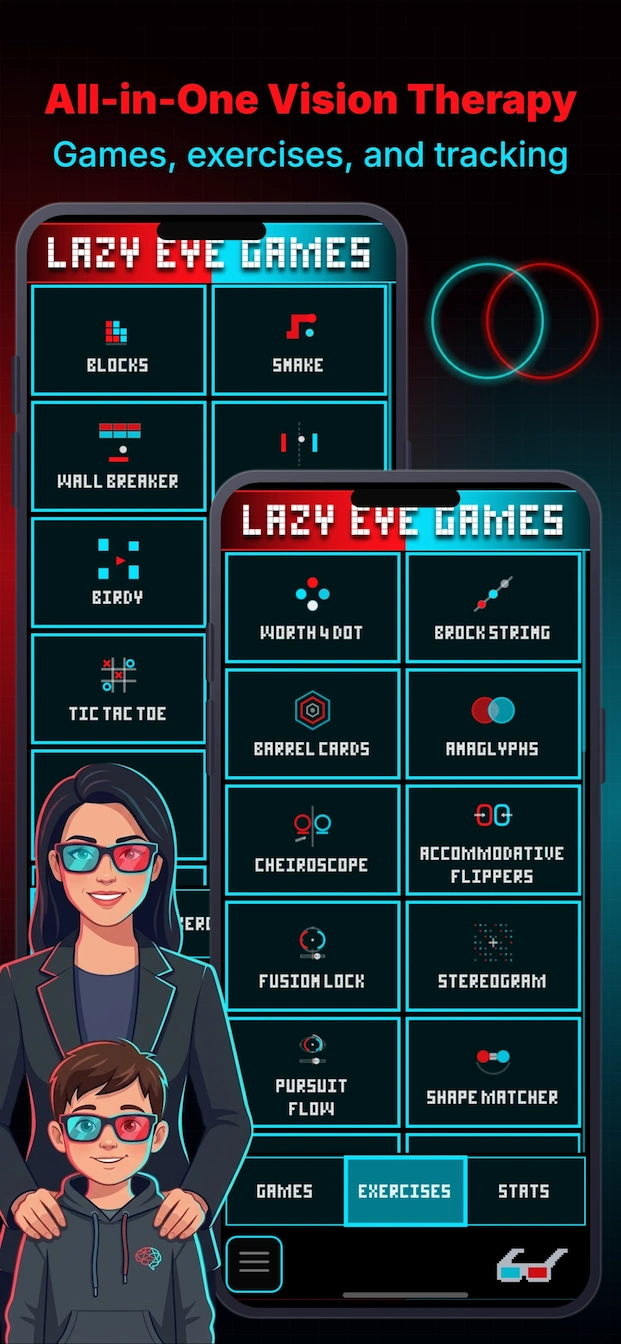
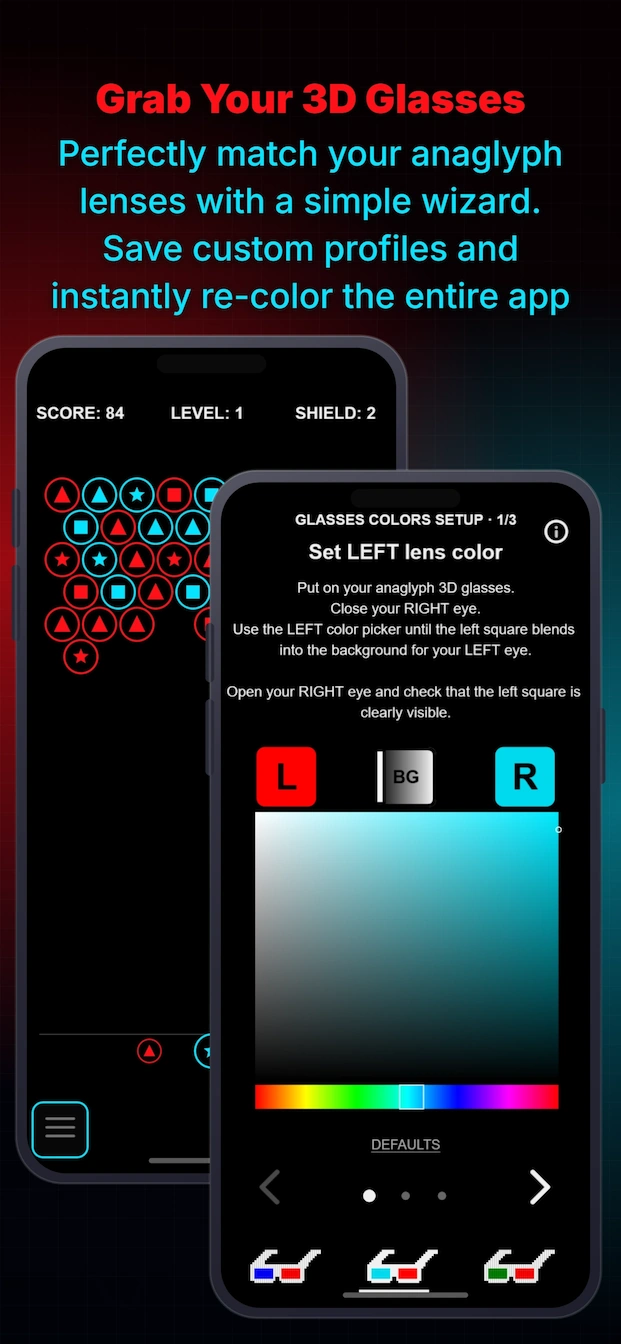
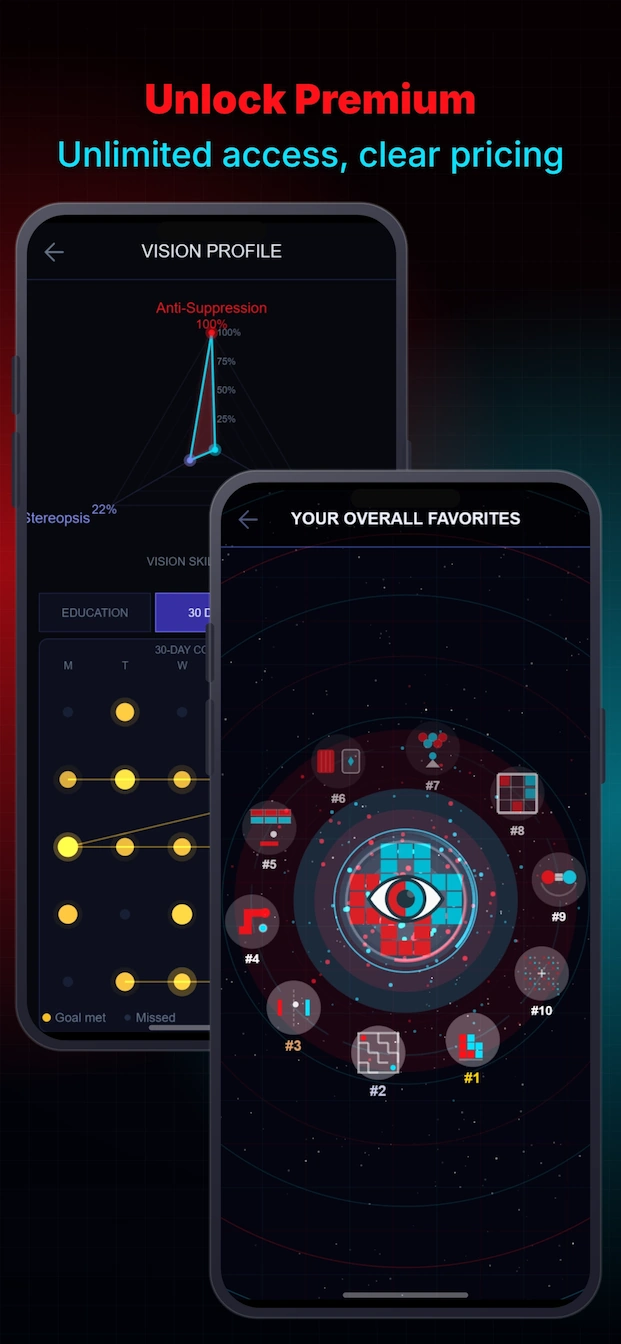
Why this broader mix matters: the app is no longer just a handful of classic titles. It now covers quick reflex work, careful scanning, route planning, word recognition, and dedicated binocular drills, so practice can stay varied without drifting away from vision-therapy goals.
Collection 01
Arcade and reflex games
Fast rounds that keep both eyes engaged while scenes move, targets shift, and timing matters.
- Blocks. Clear lines by sliding and rotating falling pieces across the full board.
- Snake. Guide the trail to targets without crashing.
- Wall Breaker. Move the paddle and keep the ball in play.
- Table Tennis. Return quick shots and beat the computer in short rounds.
- Birdy. Flap through tight gates and collect shards.
- Dino Runner. Jump, duck, and weave through speeding hazards.
- Car Racer. Steer through traffic and road hazards on a fast highway.
- Space Shooter. Dodge enemy fire, blast waves, and collect upgrades.
- Bubble Run. Pop rising orbs before they escape.
- Shape Hero. Switch lane receptors to catch matching falling pieces.
- Eclipse Runner. Tap between inner and outer lanes to dodge obstacles.
- Chaser. Collect sparks, dodge pursuers, and flip the chase with power-ups.
- Platformer. Run, jump, hover, and attack through a side-scrolling adventure.
- Bouncer. Rotate stacked rings to fall through gaps and chain descents.
- Pinball. Flip paddles, keep the ball alive, and chase high scores.
- Lane Dash. Hop forward through traffic and fill goal slots.
Collection 02
Puzzles and logic
More measured challenges for planning, scanning, matching, and whole-board awareness.
- Maze. Move one step at a time toward the exit while reading the path ahead.
- Bubble Shooter. Aim, fire, and match clusters to clear the board.
- Pivot Shot. Fire shapes into a moving path and time matching groups.
- Memory Match. Flip cards and find matching pairs.
- Sliding Puzzle. Move rows and columns until the board returns to order.
- Sudoku. Fill the grid so every row, column, and box stays unique.
- Prism. Drag mirrors to route light into the right targets.
- Switchboard. Flip switches to steer packets into matching docks.
- Spark Sweeper. Read number clues and flag hidden sparks.
- 2048. Merge tiles into larger values before the board fills.
- Shape Crush. Swap adjacent pieces to trigger combos and cascades.
- Link Pairs. Connect matching symbols with open paths.
- Flowgrid. Draw routes between endpoints without crossing lines.
- Drop Four. Stack tokens, make matches, and chase cascades.
- Shape Sort. Pour matching orbs into the right vials one move at a time.
Collection 03
Strategy, boards, and words
Slower formats that still demand binocular attention, pattern reading, and anticipation.
- Tic Tac Toe. Read quick patterns and outthink the computer.
- Gomoku. Build five in a row while spotting threats and openings on a larger grid.
- Solitaire. Sort the deck into ordered foundations with smart tableau moves.
- Power Defense. Place towers during build phases and hold off incoming waves.
- Wordlyph. Guess the hidden word using color clues.
- Link Words. Drag through letter wheels to discover each target word.
- Word Search. Trace hidden words through themed grids against the clock.
- Word Loom. Tap when two word halves meet in the center to form a real word.
Collection 04
Guided binocular vision exercises
Dedicated drills layered into the same app so therapy sessions can alternate between play and structured practice.
- Anaglyphs. Hold and release to fuse drifting shapes into one image.
- Barrel Cards. Shift between near, mid, and far levels until the target looks sharp and single.
- Brock String. Time your press as drifting targets line up into one image.
- Accommodative Flippers. Fuse the target and swipe as depth flips back and forth.
- Fusion Lock. Center a split ring and hold it single through position changes.
- Vergence Bridge. Adjust the bridge and keep it single while the shuttle crosses.
- Pursuit Flow. Follow a moving bead and keep the target fused into one point.
- Fixation Field. Keep the center reticle single while noticing brief outer flashes.
- Worth 4 Dot. Tap every glowing dot you can see in the cluster.
- Shape Matcher. Drag solid shapes into matching sockets before time runs out.
- Stereogram. Relax into a dot pattern until a hidden 3D shape appears.
- Cheiroscope. Trace a glowing path with steady hand-eye coordination.
- Threadline. Guide a pulse through flowing ribbon gates with smooth tracking.
How All Lazy Eye Games Work
Every game in the collection is built on the same proven principle: dichoptic stimulation. By assigning different game elements to different color channels and using anaglyph 3D glasses, each eye receives only part of the visual information. The brain is forced to combine both inputs to play the game, gradually retraining itself to use the weaker eye alongside the stronger one.
All games include adjustable color settings so users can calibrate the display for their specific glasses and visual needs. For setup instructions, see the Game Setup Instructions guide.